
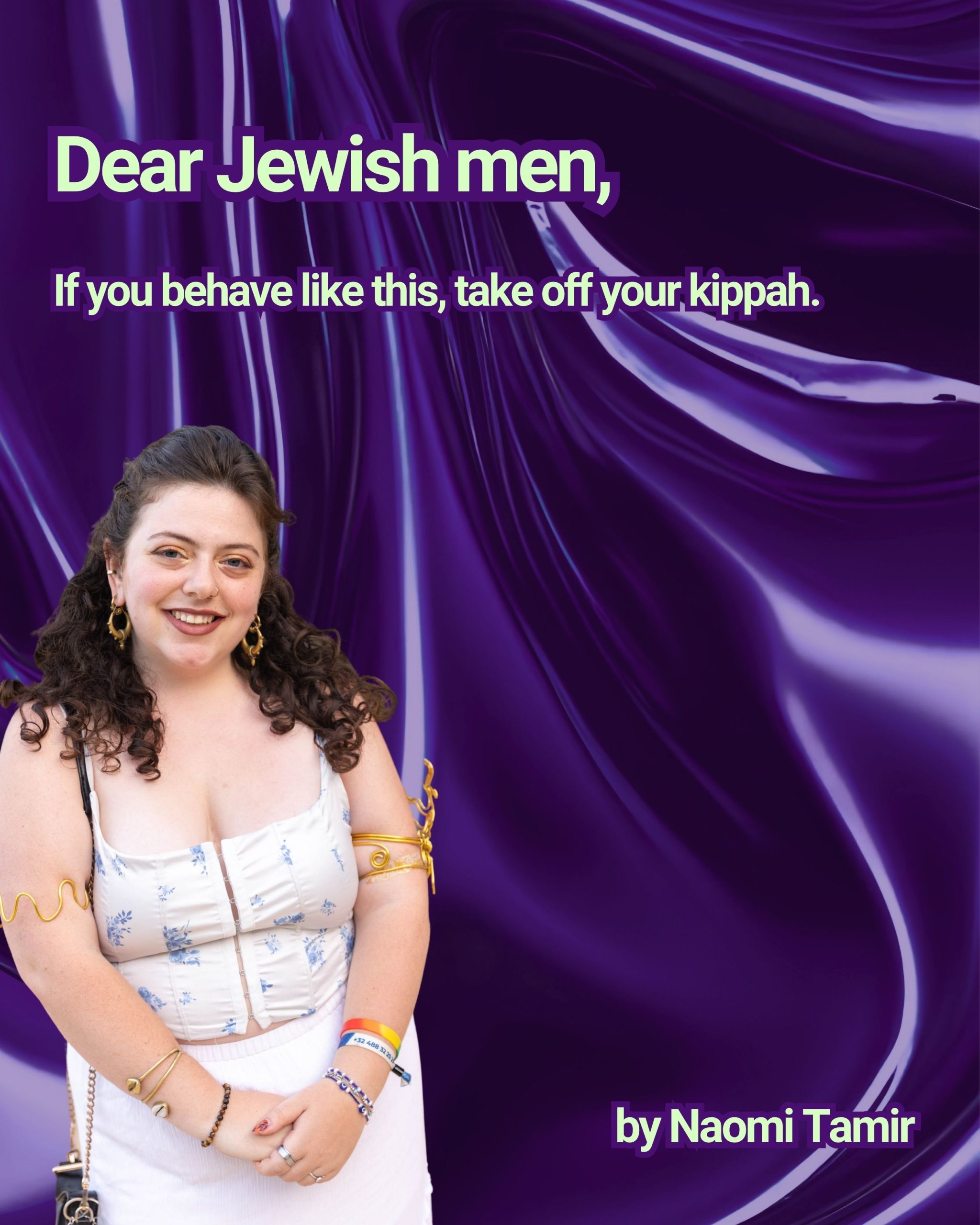
When I visited a non-Jewish German friend in France, we joined his Spanish friends to go dance at a club – like one does on a Sunday night. Randomly, a stranger broke through our circle, trying to get my attention. It was weird, but not an uncommon experience as a woman. One of the Spanish guys noticed and helped me out of that situation. Suddenly, I hear one of the Spanish girls whisper to me, “He’s a Zionist.” At this point, while recovering from the harassment, my brain tried to prepare for the antisemitism that was about to follow. I turned around to assess her claim and sure enough, the dude wasn’t just wearing any kippah, but one that read “I.D.F. Israeli Army.”
Now, here’s the thing: I tell people that I’m Jewish and I tell people that I’m Israeli. Which means I have been painfully aware – from a young age – that whether I want it or not, my behavior and the way I am perceived is reflected on us as a people. This particular French Jew seemed to be blissfully unaware. He came back again, did not leave me alone and tried to dance with me from behind until he was told by one of the girls in French to leave me (tf) alone. Nothing antisemitic happened that night – meanwhile they saved me from a guy that could not have cared less.
At first, I was angry. Why? The most common explanation for why you should wear your kippah is to be reminded that there is a higher power above you. A higher power that is watching you and has commanded you to follow mitzvot. The wearing itself is a minhag, not a mitzva. So how about prioritizing good deeds above wearing a kippa for mere symbolism?
This isn’t about one single Jewish man, though. I am angry because this experience was the cherry on top of male behavior that is excused far too often within the community. This experience raised a series of questions to which I might have an answer or.
From what I observed, there is a desecularization happening in our community, specifically among men since the Seventh of October. However, it is not necessarily connected to a newfound belief in God, going to synagogue every Shabbat, and reflection in one’s lifestyle.
So here is my thesis: for some of those attempting to reconnect to faith, specifically by practice of the Minhagim and Mitzvot reserved for men in Orthodox Judaism, they are subconsciously attempting to gain confidence and masculinity from identity.
Even before the Seventh of October happened, antisemitic threats were on the rise, and with them, the community’s desperate cries for protection. Historically and now contemporarily, Jewish men have been emasculated and depicted as weak and small – yeah, in both interpretations. Yet, the understanding of manliness is still rigid, defining that men are supposed to be hyper-strong protectors by certain social standards, and especially online movements. It is perceived in direct contrast to one another. I’m taking out one exception: the perception of the Israeli army because this would open a whole other dimension to the question. We are in the diaspora here.
In the diaspora, one common response has been to hide. I have my personal opinion towards hiding every aspect of Jewishness as a survival strategy, because in the end, that’s all it is: a coping mechanism for survival. In the long term, one cannot live with this constant fear, which is precisely how we ended up here: with a generation of men feeling emasculated and discriminated against, paired with the societal influence of the manosphere, who are turning around 180 degrees trying to show the world, “I’m not afraid.” I’ve met them, you’ve met them; there are many ways their behavior shows, but most commonly they are the ones who walk around with a visible Magen David, occasionally in notorious areas, almost as if they are waiting for that confrontation to happen. Hoping to prove to someone that they are not weak.
I can understand where it comes from: because of our Jewish identity, we fall victims to isolation and discrimination. However, because we don’t want to identify as victims, we look to transform it into our source of strength. Judaism can give you very clear instructions in this case, like prayers for certain moments, holidays, and a bonus of practices that are reserved for men. Male-only rituals become especially attractive because they emphasize a specifically masculine religious role. I know the common explanation that we women are exempt from the burden, but in the end, in Orthodox Judaism men get to do the extra thing and women are not exempt but often explicitly barred.
Above all, the Jewish community is the most important aspect of Jewish identity even within religious traditions, which is why many found comfort in young adult events. Initially this is great, but when we observe a questionable pattern unfold in the behavior of our male counterparts, it calls for a critical examination. When a man’s sense of worth becomes tied to proving his masculinity, women easily become part of that proof.
Like when some men come to events for no other purpose but to scout a potential wife, in a way that’s not romantic, not classy and certainly not attractive – rather desperate. This happens because certain men now don’t just feel rejected by women, but by society as a whole. The isolation is what channels frustration, which is a pattern I recognize from broader incel culture, which can be extremely dangerous but also shows in varying intensities. This frustration manifests in worldviews and behaviors in which these men – simply because they are Jewish – feel entitled to women who came to a social event – for fun, or community, or both. Here too, I know that you have at least one person in mind when reading this.
When addressing these issues, we can’t leave out the way this is often intended and enabled under the guise of “preventing marrying outside of the community”. This does not just increase social pressure on women and take away spaces, but it profits off the fear of contact with the outside society.
So what’s my conclusion?
Dear Jewish men, yeah, you too, have to do some reflecting on your masculinity. Maybe acknowledge that you are afraid – because guess what – you’re allowed to feel afraid.
Just A) don’t take away spaces that are supposed to be there for us all. We are not just potential girlfriends, potential wives or potential mothers. Strive to be like that guy that saw me uncomfortable and helped out, especially when it’s one of your friends being that guy.
B) Confidence doesn’t come from external validation. If you want to explore religion, please do. Since Judaism is an ethno-religion, you can also find your own way, which can be more challenging. But when it’s authentic, knowing your identity can absolutely bring you peace and pride, especially once you understand that you don’t need to prove yourself to anyone.
Most importantly, C) you exist in a wider society that, as you know, has a weird relationship with Jews. I’m not asking you to be a perfect person and never jaywalk or whatever, but please, be aware that this society is double as hostile towards us, the Jewish women. Don’t be part of the problem. Be part of the solution.
von Naomi Tamir, JSUD Vorstand
veröffentlicht am 05.09.2026