
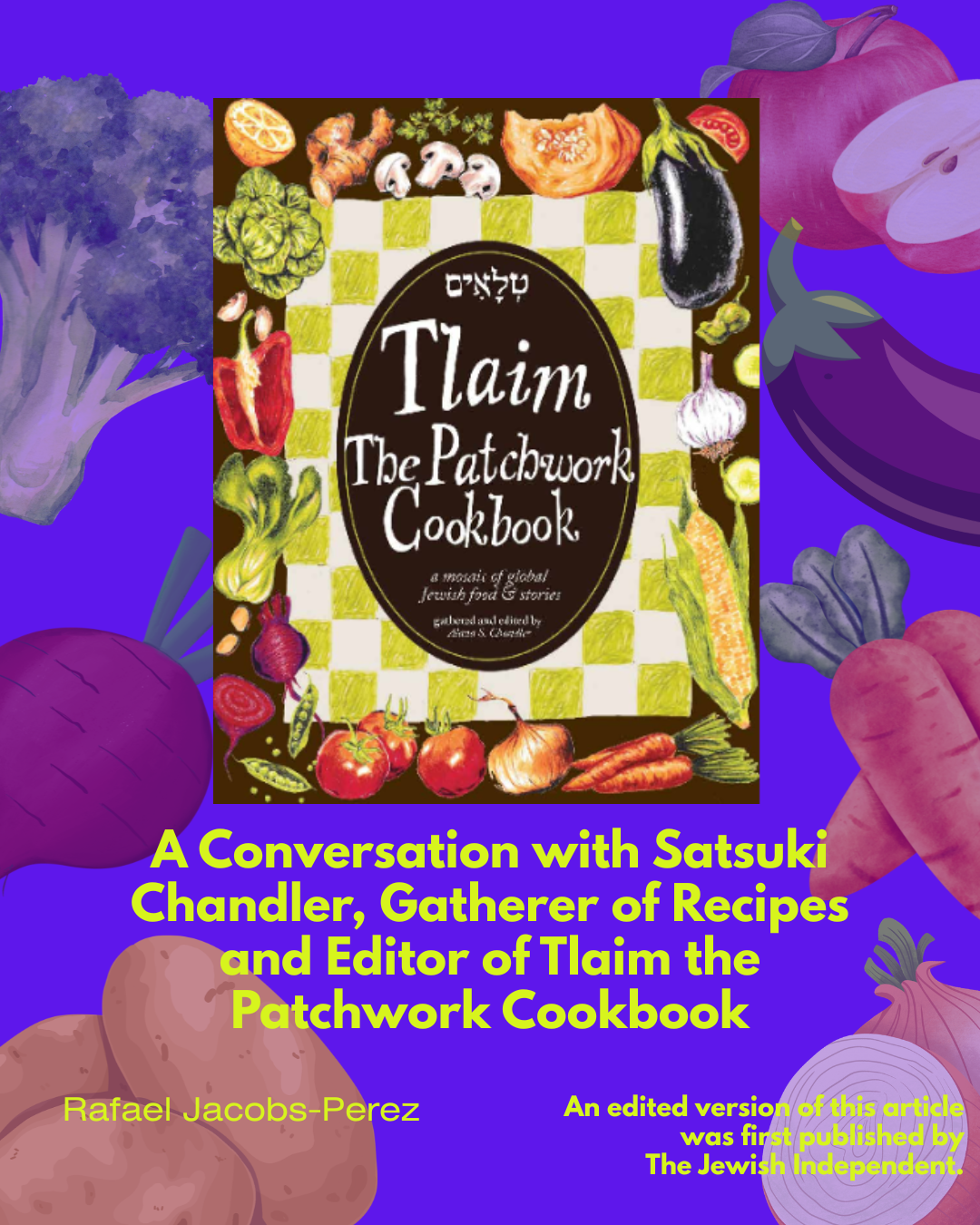
Tlaim, The Patchwork Cookbook is a nonprofit cookbook holding over 80 recipes spanning the Jewish Diaspora. Each recipe is accompanied by stories that reflect the diversity of the Jewish community. From Matzah Chilaquiles to Urwuk Patties, you can taste the flavors and learn about Mexican Ashkenazim and Sephardi Iraqis. The idea for the book emerged from a small project that its editor, Satsuki Chandler, created over ten years ago for a research internship that they did in high school. Over the last six years, the cookbook has been quilted together with almost no in person contact or meetings. I was lucky enough to be able to set up a call to get to know about the cookbook and Satsuki Chandler, both of which are full of surprises and heartwarming.
A Gatherer of Recipes
Satsuki Chandler grew up in a Japanese Ashkenazi household in Chicago where food seemed to always be a big part of their life. They made and sold their own granola and other baked goods in high school, and while they are currently working through Graduate school, they use baking as a sensory experience that helps them balance the measuring of hard science. They explained to me that their mother began playing with the recipes from their paternal grandmother, adding Japanese twists to traditional Jewish dishes. However, growing up they found that in their schools and synagogues other Jews of color were hard to come by, let alone another Japanese Ashkenazi. This desire for finding and amplifying the voices of Jews with underrepresented experience and identities led them to helping create Tlaim. The cookbook was inspired not only from Satsuki’s lived experience and faith but also from two questions that they posed to me during our conversation: How can we craft our own traditions? Who gets to decide when new rituals are reinvention versus inauthentic bastardization? After seeing non-normative ways of being Jewish often pushed to the wayside, Satsuki wanted to create a space where rituals, new and old, were given equal space to be celebrated and honored. As the first generation of their particular blend of backgrounds in their family lineage these questions weighed heavily on their mind, until submissions began to come together, painting a picture of a Jewish world that was full of centuries of reinvention and plenty of new traditions that tasted just like home.
They self-identify not as an author or editor but as a gatherer of recipes. Throughout our conversation, they constantly thanked the different people that helped to create the cookbook from their fiscal sponsor the Be’chol Lashon organization for Jews of Color, the illustrator Brígh Marie Johnson, to the over seventy volunteer recipe testers who wrote in from all over the world to taste test the submissions. Each submission was tested at least two times for quality control. From their perspective Satsuki uses the title gatherer, rather than editor or creator, because for over six years they reached out to celebrities like Molly Yeh from the Food Network to strangers online through a google form and calls for submission on Instagram for anyone that wanted to share their version of Jewish food. “It is truly a community authored cookbook, because this project would not have been possible without the collective submissions and effort from each individual that contributed,” Satsuki said.
A Patchwork Cookbook
Satsuki explained to me that Tlaim is more than just a cookbook, it is made to celebrate the diversity of the Jewish diaspora, it is a project that elevates the stories of underrepresented Jewish identities, and it is a place where the discrimination and challenging experiences that can be found within the Jewish community is not relegated to the sidelines. The book has over eighty recipes, with dishes like Borscht Gazpacho, Saffron Lentil Soup, Nasi Tumpeng, and Kinako Mochi Doughnut Hole with Kuromitsu Syrup. Contributors were then asked if they would like to be interviewed to have their stories paired with their recipes. The interviews led to moments of connection for Satsuki and some answers to the questions that had inspired them to begin the cookbook. Contributors spoke about the weaving of known and unknown traditions into one, and how food is a place that can be a creative outlet and a connecting force. The pieces that make up this patchwork cookbook give the recipes and cultural contributions of Jews of color a moment in the limelight.
Finally I asked Satsuki about their favorite recipes and their response, like the recipes were all encompassing. The scallion pancake challah that she was luckily able to try before becoming vegan, and since becoming vegan the tofu kreplach! Now that the project is done, they told me that they are happy to see the book out there in the world, with the hope that it will inspire Jews in the diaspora to try the recipes and maybe even to share some dishes of their own.
Donations can be made when purchasing a copy of Tlaim and a portion of these donations will then be sent to World Central Kitchen to provide food aid to those in humanitarian crisis. Satsuki and the authors of the recipes voted on this organization to recognize that while this cookbook is about representing the vast diversity of Jewish cuisine there are millions of people struggling with food insecurity all over the world. In the meantime, Satsuki will be attempting to veganify the recipes in Tlaim and they ask if anyone tries any of the dishes to DM pictures to the Tlaim Instagram so they can feature your creation on the project’s social media.
You can find both the cookbook and the instagram below!
Instagram: @tlaim.cookbook
Link to Tlaim: https://globaljews.org/innovation-hubs/tlaim/patchwork-cookbook/
by Rafael Jacobs-Perez. An edited version of this article was first published by The Jewish Independent and by EDA on the fgfffg.